

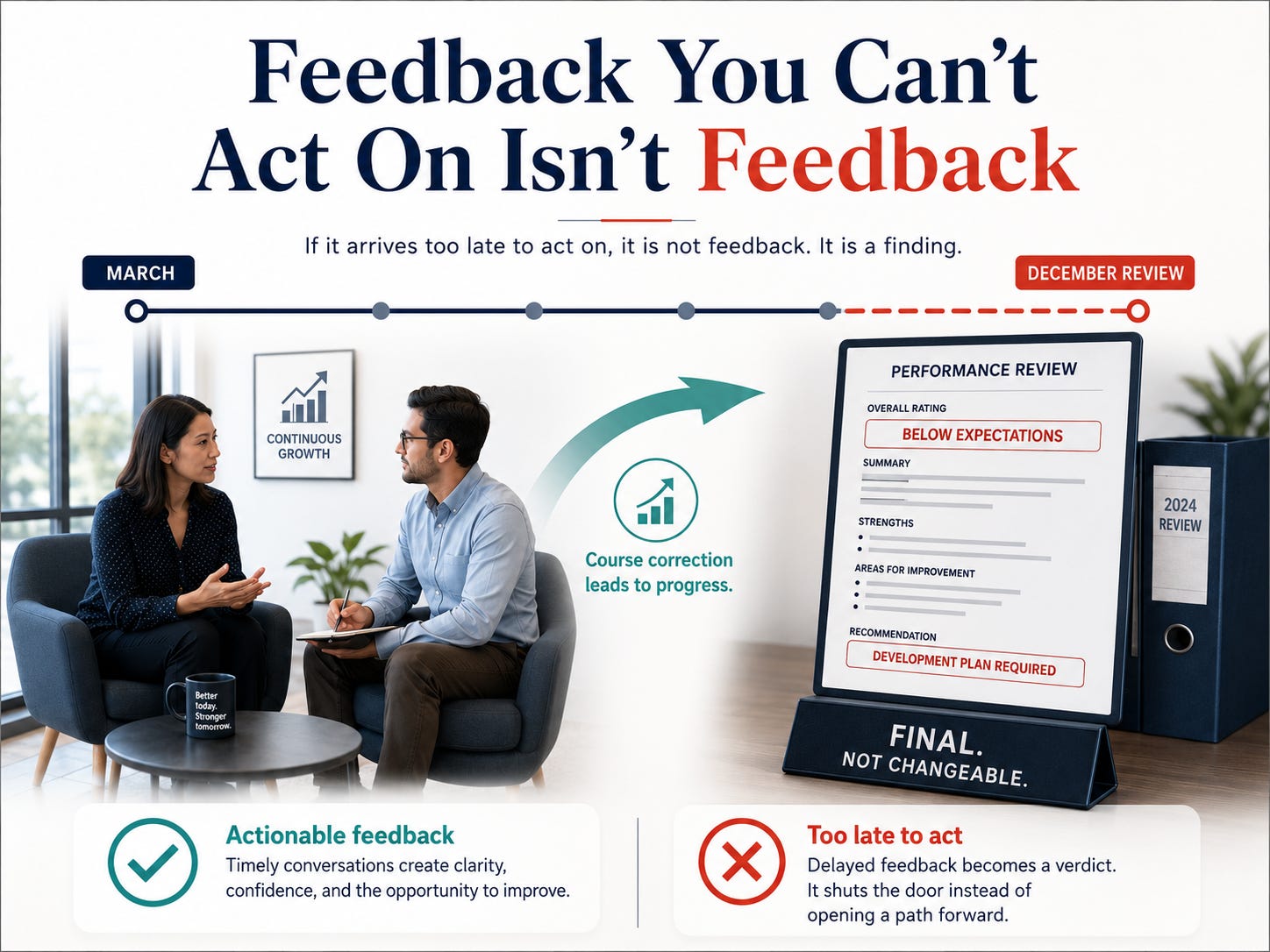
Every line in a performance review should have to answer one question. Could this have been said sooner, while I still had time to do something about it? If the honest answer is yes, then the review is not where that feedback belonged. It is where the feedback went to be useless.
Feedback has exactly one purpose. It gives a person the chance to correct course or improve. That is the whole function. And it only works if it arrives while there is still time to act on it. Delivered in the moment, a hard note is a course correction. Delivered for the first time at the annual review, the same words are a verdict, because the year they describe is already closed. The information did not change. The timing removed the only thing that made it feedback: the opportunity to respond.
One caution before the argument, because it is easy to misread. I am not arguing for reviews that are soft, or empty, or free of hard truth. A good leader owes you the hard truth plainly, and some of it will sting. The issue is not whether feedback is difficult. It is whether you were ever given the chance to use it. Feedback you could have acted on in March is worth almost nothing in December.
Take the manager who notices something in March and says nothing, watches it again in June and still says nothing, and then raises it in the December review as a pattern. Set aside whether the point has merit. The employee was denied the one thing feedback is supposed to provide: a chance to fix it before it counted against them. Every month the manager stayed silent was a month the person could have used, and didn’t get.
Follow that and it gets uncomfortable. A manager who withholds feedback all year has not been gathering evidence. They have been running out the clock. The silence was not patience, and it was not them waiting for the right moment. It was the removal of every right moment, one by one, until the only one left was the moment you could no longer do anything but receive it.
So why do managers do it. Rarely laziness. Real-time feedback is uncomfortable, and the review is the sanctioned place to finally say the thing, safely, on a schedule, when the person across the desk can no longer push back or fix it or prove you wrong. It is the most comfortable possible way to be honest, which is another way of saying it is not quite honesty at all.
This is where most organizations get performance management wrong, and few will say it out loud. They grade a review on whether it is thorough, on time, and consistent with the calibration. They almost never ask the only question that matters to the person receiving it: did you ever actually have a chance to act on any of this. A complete, well-documented, perfectly timed review can still be a failure, if everything in it is landing on the employee for the first time.
So what does good look like. Not a better template or a tighter cadence. It is feedback delivered close to the moment that prompted it, while it can still change the outcome. It is a leader willing to have the small, awkward conversation in March instead of banking it for a document in December. By the time you sit down for the review, nothing in it should be new, because every hard thing was already said when you could still use it. The review does not reveal. It summarizes. A surprise in a review is not proof your manager was finally honest. It is proof you were denied the chance to improve.
Which is, finally, why I care about this one. I have sat in a review and been handed feedback for the first time that, had anyone raised it months earlier, I could have done something with. That was the hardest part. Not the content, and not the score. It was knowing that the chance to respond, to adjust, to prove the read wrong or to make it right, had been quietly held back until the moment it could no longer help me. You cannot course-correct on the last day. By then it is not feedback. It is a finding.
So build the other thing. Give people the hard note when they can still use it, in March, while it is still just a conversation and still fixable. Make the review the least surprising day of the year, because everything in it was already said in time to matter. Feedback that arrives only when a person can no longer act on it was never really for them. It was for the file. Read the symptom. Then go build the place where fewer of them ever start.