

The grievance had been sitting on my calendar for eleven days.
A maintenance technician at a multi-site manufacturing facility. Thirty-two years with the company. He had requested a modified workstation six months earlier after a documented injury changed what he could do physically. Six months of forms. Six months of back-and-forth between HR generalists and a third-party leave administrator and a supervisor who kept insisting the accommodation was ‘not operationally feasible.’ Six months of a man showing up every day to a job he could still do, in a building that had decided it would rather document its process than solve its problem.
I sat across from him in a conference room that smelled like burnt coffee and old carpet. Drew Soule, HRBP, Southeast Wisconsin, theoretically there to represent the company’s position. And I thought: we have failed this man with extraordinary thoroughness.
I am not telling that story for pity. Not his, and not mine. I am telling it because that grievance hearing is where I understood something that took me another four years to fully articulate: compliance-based disability inclusion has never been about inclusion. It has been about liability management dressed in the language of care. And the distinction matters enormously, because one of those things actually helps people, and one of them mostly helps the company’s legal posture while the person sits in a conference room for six months waiting for a different chair.
I was born with a physical disability. I use a wheelchair. I have navigated every element of a professional career in a world that still designs its physical and organizational infrastructure around the assumption of able-bodied participation. That experience is not incidental to my work as an HR leader. It is foundational to it. I say that not for pity, and not for applause.
## The Compliance Framework Was Designed to Protect the Organization, Not the Employee
Here is the thing most disability inclusion content will not say plainly: the ADA interactive process, as practiced in most organizations, is an adversarial framework with collaborative branding.
It was written and implemented primarily to define the legal boundaries of employer obligation. What counts as reasonable. What constitutes undue hardship. What documentation satisfies the standard. Every step in the process has a legal analog, and HR professionals learn to execute those steps with precisely enough care to defend the process, not necessarily to serve the person.
I am not blaming HR practitioners. I am one of them. I have run that process dozens of times across healthcare, manufacturing, and tech environments. I have seen it handled well and I have seen it handled badly, and even when it is handled well, it is often still fundamentally oriented toward risk containment rather than outcome achievement.
The outcome being: a qualified person who wants to work, continuing to work.
That sounds simple. It is not simple in a framework designed around documentation requirements. It becomes a project management problem instead of a problem-solving conversation, and the person waiting for the answer loses months of professional continuity while HR and legal and the third-party administrator exchange emails.
The contrarian take I am prepared to defend: compliance-based disability inclusion has been a managed failure. Not a failure of effort. Not a failure of intent. A structural failure, because the structure was never built to optimize for the employee’s success. It was built to optimize for the organization’s defensibility.
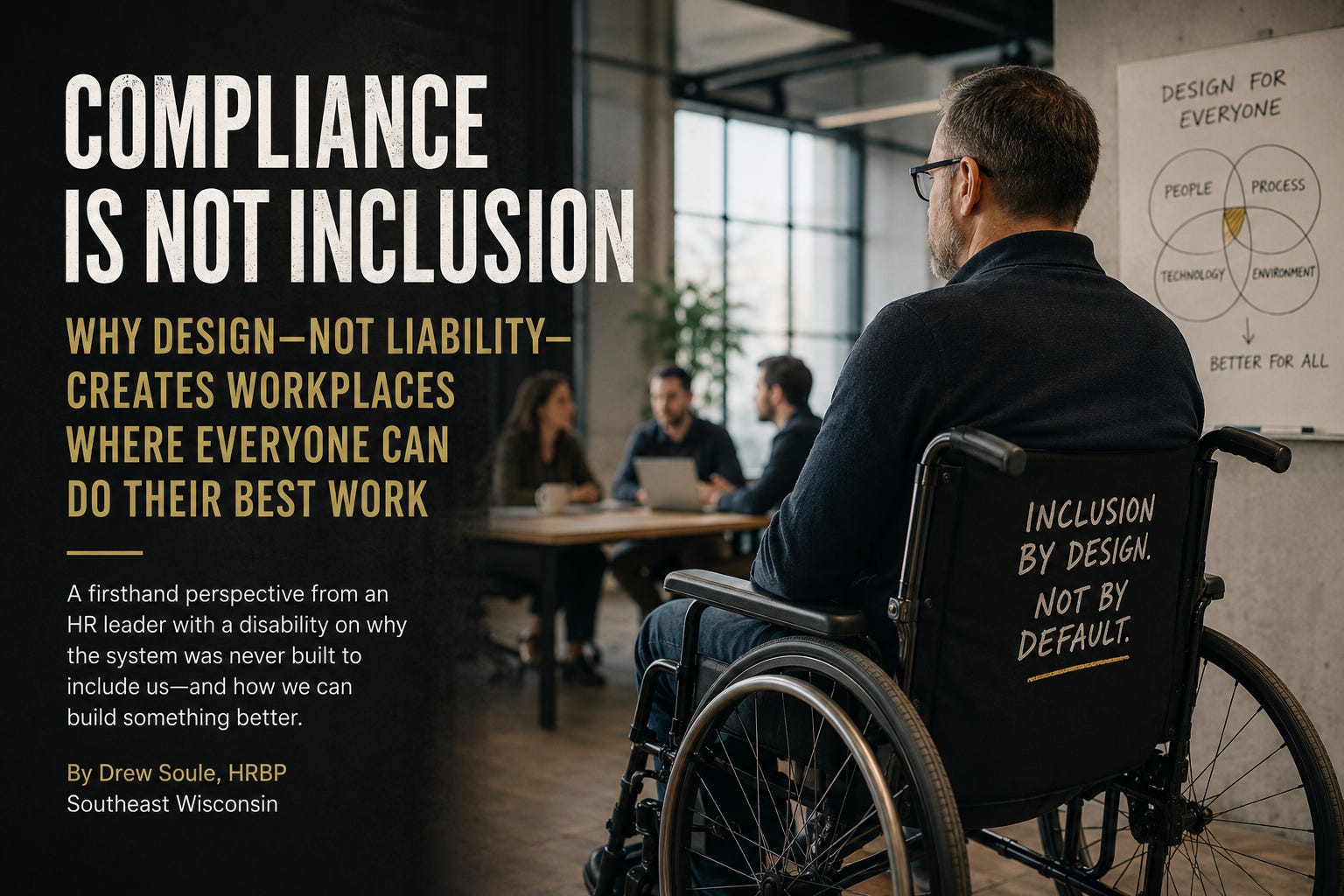
Design-based inclusion is different in a way that is not semantic. It asks a different first question. Not ‘what are we required to do?’ but ‘what does this person need to do this job well, and how do we build that in from the start?’
## What Design-Based Inclusion Actually Looks Like in Practice
I have been in rooms where this conversation goes right and rooms where it goes wrong, and the difference is almost never resources. It is almost always imagination and the willingness to treat the person as the expert on their own situation.
The technician from that grievance hearing needed a modified workstation height and a different tool storage configuration. Total cost, once someone finally asked the facilities team to look at it: four hundred and thirty dollars and two days of work. The six months of process cost the organization far more than that in administrative overhead, union relations damage, and the very real possibility of losing a thirty-two-year employee who knew things about that line that no one had bothered to document.
Design-based inclusion means organizations stop treating accommodations as exceptions and start treating accessibility as a default design parameter. It means that when you are building a new workflow, a new onboarding process, a new performance review system, someone in that room is asking: who does this exclude, and is that exclusion necessary?
I build HR workflow automations using the Claude API. When I am designing a workflow, I think about the inputs, the context windows, the architectural choices that determine whether the output is useful or just fast. The same discipline applies to org design. If you do not think about who the system fails at the design stage, you will find out who it fails at the grievance stage. That is a worse place to find out.
This is not about lowering standards. It is about questioning assumptions baked into standards that were written without disabled employees at the table. Drew Soule HR consulting work keeps returning to this point across every sector: the organizations doing this well are not doing it because they are more compassionate than other organizations. They are doing it because they have stopped treating inclusion as a compliance exercise and started treating it as an operational design problem with operational solutions.
## The Prediction Most HR Leaders Are Not Ready For
Here is where I am prepared to pick a fight with prevailing HR thinking.
Within the next decade, the organizations that built disability inclusion into their workflow design and workforce planning infrastructure will have a measurable talent advantage over organizations that did not. Not a feel-good advantage. A structural one.
The labor market is tightening in ways that are not going to reverse. The workforce is aging. Chronic illness and disability rates are rising, including among working-age adults. Remote and hybrid work infrastructure, when it is built thoughtfully, removes whole categories of access barriers that previously kept qualified people out of certain roles. AI-assisted workflows, when they are designed with accessibility in mind, can extend the productive range of employees who previously would have been accommodated into narrower roles or managed out entirely.
The organizations that figure this out first are going to access talent pools their competitors are still ignoring. That is not idealism. That is workforce planning.
When I diagnosed that 53% of exits at a healthcare organization were happening within the first 90 days, the pattern was hiding in plain sight across qualitative exit data and manager-level cohort analysis. Redesigning onboarding based on what that data actually said produced a 22% attrition reduction and over $400K in measurable cost avoidance. The insight was not complicated. It required someone willing to ask why instead of just noting that turnover was high.
The same question applies to disability inclusion. Organizations are not asking why their accommodation processes take six months. They are noting the compliance metrics and moving on. Someone needs to ask why. And then someone needs to fix the thing that is actually broken.
I am building this work out of Southeast Wisconsin. The context here is specific: manufacturing floors, distributed workforces, union environments, organizations that have been doing things a certain way since long before disability inclusion had a framework attached to it. That context is not a limitation. It is a laboratory. The problems here are real and the solutions have to work in conditions that are not controlled or coastal or theoretical.
I have been the person in the room who was not expected to be there. Not just in the disability sense, though that is real, but in the career sense, the room sense, the you-do-not-quite-fit-the-model sense. I am not the brightest bulb in the string of lights. But I have kept it burning long enough to know the difference between a system that is trying to include you and a system that has designed you out and is now managing the paperwork.
The difference is everything.
Compliance told that maintenance technician to wait six months. Design would have asked him on day one what he needed, built it in, and moved forward.
We have the tools. We have the data. We have the workforce pressure that makes this a business case and not just an ethics case.
The question is whether HR leaders are willing to stop protecting the process and start redesigning it.
That answer is overdue.