

There is a moment in every calibration session where the room goes quiet in a particular way.
Seven leaders are looking at the same name on the same slide. The performance is there. The delivery is there. The numbers are fine. But the attrition on that team has been climbing for two quarters in a row, and nobody is saying the obvious thing. So I say it.
“Who is doing the one-on-ones?”
Sometimes the answer is silence. Sometimes it is a version of “I think they are doing them.” Sometimes a peer looks at their shoes. What I have never heard in that moment is a confident, specific, verifiable answer. And that absence tells me everything I need to know about why people are leaving.
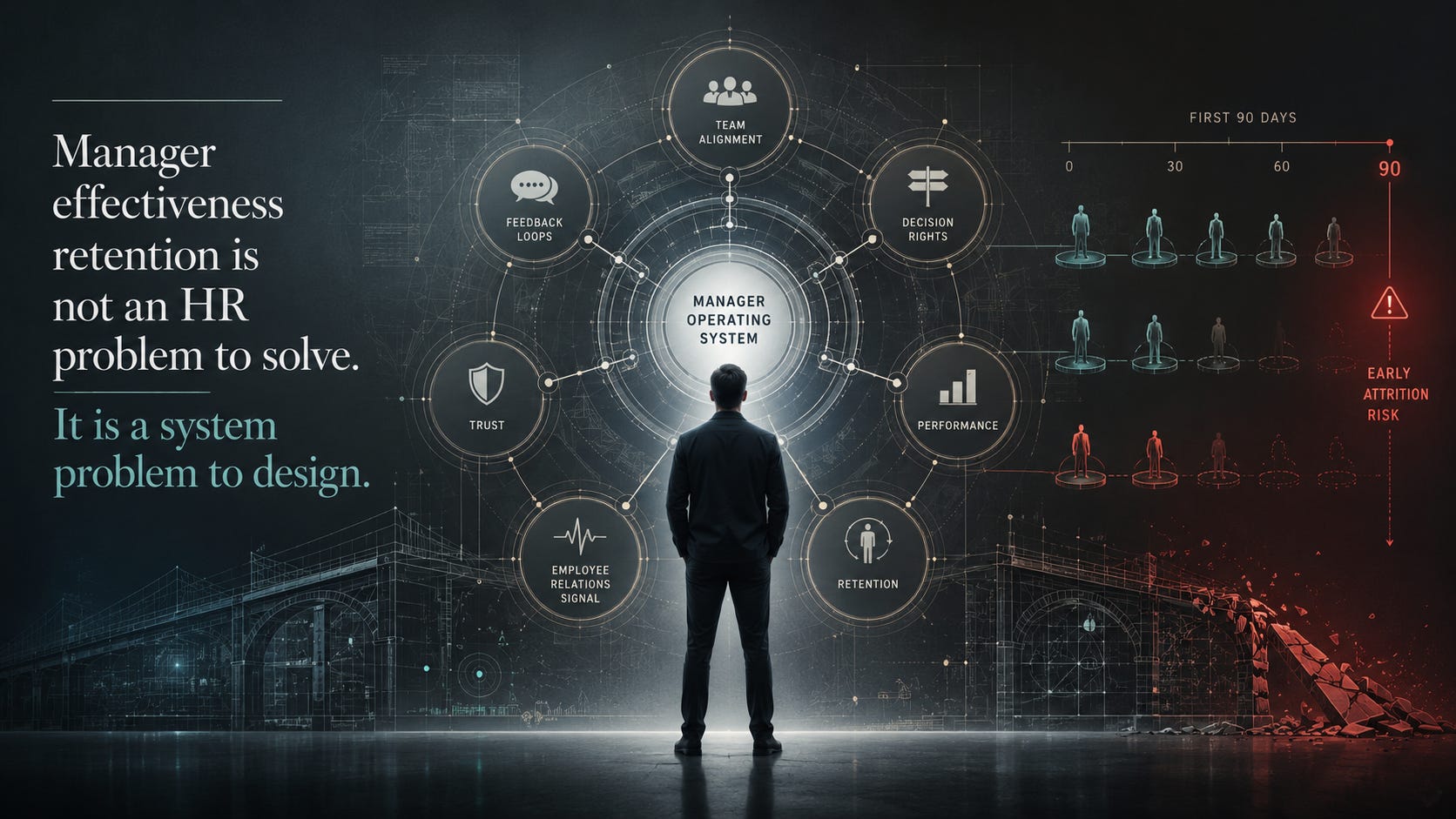
Manager effectiveness retention is not a training problem. It is not a survey problem. It is not a culture statement problem. It is an operating system problem. And most HR functions are solving it with the wrong tools.
The Thing We Keep Measuring Instead of Fixing
Here is a number that should make you uncomfortable: Gallup has been publishing research for twenty years showing that managers account for at least 70 percent of the variance in employee engagement scores. Not culture. Not compensation. Not benefits. Managers.
We know this. We have known it for a long time. We put it in presentations. We reference it in talent reviews. And then we go build another listening program, launch another engagement survey, and wait for the results to tell us the same thing they told us eighteen months ago.
The problem is not that we lack data. The problem is that we have been using engagement data as a diagnostic when what we actually need it for is accountability. Those are not the same thing. A diagnostic tells you something is wrong. An accountability structure tells someone they are responsible for fixing it.
Amy Edmondson’s work on psychological safety has been absorbed by enough HR teams that the language shows up everywhere. Safe space. Speak-up culture. Psychological safety training. What almost nobody has done is take that research to its operational conclusion, which is this: psychological safety is not an org-wide variable. It is a team-level variable created or destroyed by a specific manager’s specific daily behaviors. You cannot survey your way to it. You cannot train it into existence in a half-day workshop. You have to design a system in which managers are actually accountable for building it and given real tools to do so.
Most organizations have done neither.
First 90 Day Attrition Is Not an Onboarding Problem
When I diagnosed that 53 percent of exits at a healthcare organization were happening within the first 90 days, the first assumption in the room was onboarding. The portal. The paperwork. The orientation agenda. I understood the instinct. It is concrete. It is fixable. It is also wrong.
Onboarding is infrastructure. Infrastructure matters. But people do not leave bad portals. They leave managers who did not make them real.
What I mean by that: a new hire in the first 90 days is doing two jobs simultaneously. The first job is learning the actual job. The second job is figuring out if they made the right decision. They are reading every signal. The manager who reschedules the one-on-one twice in week two. The team meeting where nobody introduces them. The first project where they are handed a brief and told to figure it out. These signals are not neutral. They are data. And that new hire is running them through a very simple decision algorithm: is this a place where I can do my best work, or did I make a mistake?
First 90 day attrition is a manager effectiveness problem wearing an onboarding costume. The solution is not a better welcome packet. It is a structured manager operating system for the first 90 days that is specific, observable, and accountable. Not a checklist. A system. There is a difference. A checklist is something a manager completes. A system is something that fails visibly when a manager does not show up.
Role clarity, intentional relationship-building, early meaningful work, and explicit feedback loops do not happen by accident in the first 90 days. They happen because someone designed them to happen and built accountability into the design.
What a Manager Operating System Actually Looks Like
I want to be precise here because this concept gets vague fast.
A manager operating system is not a set of competencies. Competency frameworks describe what good looks like. They do not create it. A manager operating system is the set of structured, recurring practices that translate management intent into team experience. One-on-ones are part of it, but only if they happen, only if they have a structure that creates psychological safety rather than status reporting, and only if someone in the organization can tell whether they are actually occurring and whether they are actually working.
This is where most HR functions stop short. We design the practice. We communicate the expectation. We train the skill. And then we walk away and hope the behavior follows. It rarely does, not consistently, not across the full span of a middle management population.
Jeff Pfeffer at Stanford has spent decades documenting the gap between what organizations say they value about people management and what they actually measure and reward. The gap is not small. Organizations say they value people development and then promote the person who hit their number, regardless of how many people left the team in the process. That is not a values problem. It is an incentive structure problem. And incentive structures are designable.
A real manager operating system has three components most organizations skip entirely.
The first is decision rights clarity. Managers cannot operate effectively when they do not know where their authority actually starts and ends. Ambiguity on decision rights is not an empowerment strategy. It is a failure mode. People leave managers who cannot make decisions, and managers cannot make decisions when the org design has not told them which decisions are theirs.
The second is leading indicators instead of lagging ones. Attrition is a lagging indicator. By the time it shows up in your data, the decision is three months old. The leading indicators, one-on-one completion rates, internal mobility application rates, 60-day new hire check-in scores, team-level engagement trend lines, are available earlier and point to the manager specifically. Most organizations are not pulling these by manager and having a conversation about what they mean until someone has already left.
The third is calibration that is actually about behavior, not just performance. The calibration session I described at the beginning of this piece is not unusual. It happens everywhere. And the reason the room goes quiet is that we have built calibration processes that surface outputs but not behaviors. A team can deliver results in the short term under a manager who is slowly hollowing out the culture. The attrition starts to tell the story, but only if someone is reading it that way and only if the calibration conversation is structured to make the connection.
The Contrarian Observation Most HR Teams Are Not Ready For
Here is the thing I want you to sit with.
Universal design, the engineering principle that building for the most constrained use case creates something that works better for everyone, applies directly to this problem. Ramps are not just for wheelchairs. They are for delivery carts, strollers, luggage, and aging knees. Captions are not just for the deaf. They are for noisy rooms, language learners, and anyone watching their phone at midnight without disturbing a partner.
The same logic applies to the manager operating system. When you design a structured first-90-day manager playbook for a new hire who has no context, no relationships, and no idea how to read the organization, you have built something that works better for every new hire, not just the most disoriented one. When you build decision rights clarity for a manager who is overwhelmed and unclear on their authority, you have built something that makes every manager more effective. When you create a leading-indicator dashboard that surfaces team-level risk before it becomes attrition, you have built something that helps the strong manager and catches the one who is struggling before it becomes a crisis.
HR functions that design for the average employee are constantly playing catch-up. HR functions that design for the edges, the person with the most ambiguity, the highest anxiety, the least context, build systems that are genuinely robust. The constraint is the specification. Most of us have not made this connection.
Building from that principle changes the conversation. You stop asking “what does the typical new hire need?” and start asking “what does a new hire need when everything else is stacked against them?” The answer to that second question is the system that actually works.
This Is Not a Middle Management Problem
I want to be precise about one more thing.
This is not an argument that middle managers are failing. It is an argument that we have been setting them up to fail and then measuring the outcomes as if they are personal.
Most managers in most organizations received a promotion based on individual performance, a title change, maybe a training program, and then an expectation that they would figure out the rest. The operating model was never handed to them because the operating model was never built. They are improvising. Some are very good at improvising. A lot of them are just busy.
The manager who is not doing the one-on-ones is usually not a bad person. They are a person who has fifteen direct reports, forty open priorities, a skip-level who only calls when something is on fire, and no system that makes the one-on-one feel urgent until the attrition data shows up six months too late.
That is a shit design problem, not a character problem. And HR’s job is to fix the design.
The question is whether you are going to keep measuring manager effectiveness as an output or start building it as a system. One of those is an annual survey. The other is a retention strategy.
They are not the same thing.